

Hybrid Engine Optimization (HEO)
How to Stay Visible When Search Stops Sending Clicks
Hybrid Engine Optimization (HEO) is the practice of optimizing your content to perform across two layers at once: the ranking layer (Google, Bing) and the answer layer (ChatGPT, Perplexity, Gemini, Google AI Overviews). Instead of treating SEO, AEO, and GEO as separate disciplines, HEO bakes them into a single workflow where every page you publish is built to rank, to be selected as an answer, and to be cited by AI systems.
If your rankings look fine on paper but your traffic graph keeps slumping, you’re already living inside the problem HEO is trying to solve. Welcome to search in 2026 — where being on page one is no longer the same thing as being seen.
The Quiet Crisis Most SEO Reports Are Missing
A few months ago, I pulled up a client’s Search Console next to their GA4 report. Position one for their main money keyword. Impressions up 22% year-over-year. Clicks down 31%. We weren’t losing the rank race. We were losing the click race — because Google was answering the query before anyone got to us.
This is the part of the shift that traditional SEO dashboards don’t really show. Your content might still be powering the answer. The user just never has to come find you to read it. It’s the same reason cookbook authors quietly hate Pinterest, and the same reason newsroom editors twitch when somebody says “AI Overview.”
HEO exists because ranking and being read are no longer the same outcome. You need a strategy for both, and increasingly, you need a strategy for getting cited — because citation is what brings the right kind of click back.
So What Exactly Is HEO?
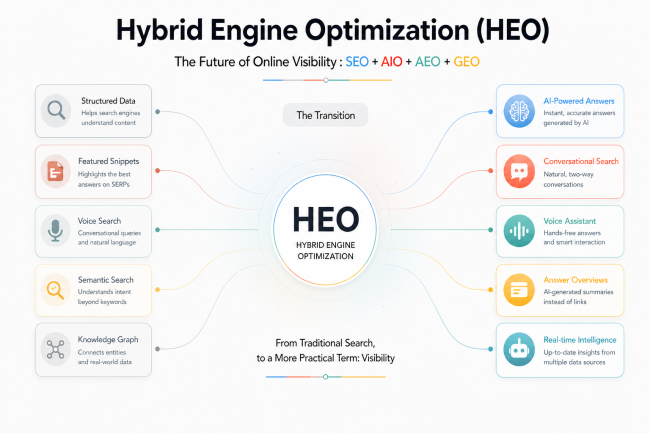
Hybrid Engine Optimization is an umbrella framework that combines three things :
- SEO — getting indexed and ranked on traditional search engines.
- AEO (Answer Engine Optimization) — getting pulled into featured snippets, “People Also Ask,” voice answers, and AI Overviews.
- GEO (Generative Engine Optimization) — getting referenced inside AI-generated responses on platforms like ChatGPT, Claude, Perplexity, and Gemini.
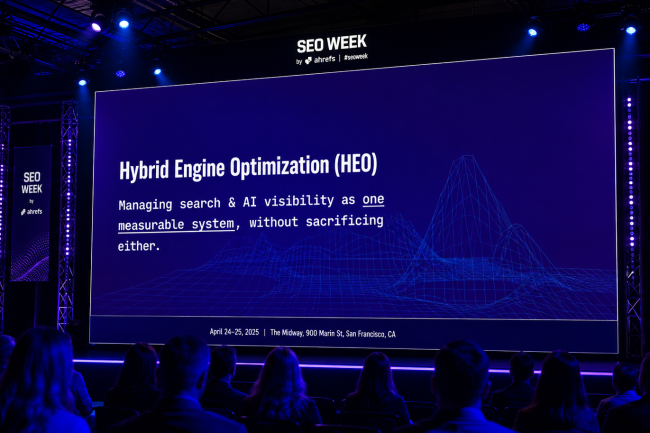
The term was popularized after SEO Week 2025, but the underlying behaviour change is what made it stick. Search now happens in layers. Old optimization stacks only handled one of those layers.
The simplest way to think about HEO is this: SEO gets you found by crawlers, AEO gets you picked by snippet boxes, GEO gets you quoted by language models, and HEO is what you do so all three pull from the same body of work instead of pulling you in three directions.
Why “Just Doing Good SEO” Isn’t a Strategy Anymore
Strong fundamentals still matter. Nothing about HEO requires you to abandon technical SEO, internal linking, or backlinks. But the assumption that ranking equals visibility — that’s the part that broke.
A few things changed at once :
- Zero-click search is now the default behaviour, not a fringe metric. A meaningful share of queries — by most credible estimates somewhere in the 50–65% range, depending on whose study you trust — never produce a click to a website at all.
- AI Overviews insert themselves above organic results for an expanding set of informational queries, and they tend to pull from sources Google already trusts, but rephrase the answer so the user has no reason to click.
- A whole new search surface exists outside Google. ChatGPT alone reportedly handles search-style queries at a volume that would have been laughable to claim two years ago. Perplexity has carved out the “research-grade answer” niche. Voice and ambient assistants quietly route millions more.
The conclusion isn’t “SEO is dead.” It’s “SEO is now a subset of a bigger job.” HEO is the bigger job.
The Mindset Shift That Actually Matters
Most HEO advice on the internet right now is checklist content — schema this, FAQ that, add an llms.txt file. Useful. Not the point.
The real shift is mental :
- The old question was, “How do I rank #1?”
- The new question is, “How do I become the source the answer is built from?”
Those two questions produce very different content. The first one optimizes for crawlers and keyword density. The second one optimizes for being quotable. AI systems don’t reward your full article — they reward the cleanest, most self-contained 60 words inside it. If your best paragraph can’t be lifted out and still make sense, an AI won’t lift it.
This is why so much “SEO content” written between 2018 and 2023 is aging badly. It was structured for the funnel, not for the answer. Long warm-ups, narrative bridges, and “before we dive in, let’s understand…” intros are exactly the parts AI models skip.
A Working Framework : The Three Jobs Every HEO Page Has to Do
When I build content under an HEO brief now, I make sure each important page does three jobs deliberately, not accidentally.
Job 1 : Earn the Rank
This is classical SEO and it hasn’t changed much. Crawlable, fast, mobile-clean, properly internally linked, supported by relevant backlinks, targeting a real query with real intent. Nothing here is novel — but skip it and the rest collapses, because AI systems still draw heavily from sites that already rank.
A page that doesn’t rank in the top 10 for its target topic almost never gets cited by ChatGPT or Perplexity for that topic. Google’s index is, in practice, the qualification round.
Job 2 : Earn the Snippet
This is where the writing style changes most. Each major section should open with a direct, lift-out-able answer in roughly 40–80 words, then expand. Question-shaped H2s help. So do tight definitions, comparison tables, and ordered steps where they’re genuinely warranted (not where they’re padding).
A useful test: if I copy any single section out of the article and paste it into a Google Doc by itself, does it still answer something? If the answer needs the rest of the article to make sense, AI systems will treat it as filler.
Job 3 : Earn the Citation
This is the GEO layer and it’s the least-understood. AI models cite based on a combination of (a) the entity strength of your brand, (b) how quotable your prose is, and (c) how often you appear in their training and retrieval data — which means your off-site footprint matters more than ever.
Practical signals that move this needle :
- A clear, well-defined About page that establishes your brand as a recognizable entity.
- Author pages with real credentials — not lorem ipsum bios. Models weight named experts more than anonymous publishers.
- Original data, screenshots, or findings the model can’t get from a competitor.
- Consistent brand mentions across third-party sites, podcasts, Reddit threads, YouTube transcripts, and trade press. AI retrieval pipelines pull from all of these.
That last point is the one most teams underestimate. If your brand only exists on your own domain, you’re invisible to half of how generative search builds its answers.
A Practical HEO Workflow (The One I Actually Use)
This is the version that has survived contact with reality, not the version that looks pretty in a slide deck.
1. Pick the query, then write the answer first
Before drafting anything else, I write the 50–80 word direct answer that I’d want an AI to pull. If I can’t write that cleanly, the topic isn’t sharp enough yet.
2. Build the page around that answer
The opening paragraph either is that answer or directly leads into it. Headings are phrased the way a human would actually ask the question, not the way a keyword tool spits it out.
3. Add at least one thing the rest of the internet doesn’t have
Original screenshot. Original number from your own data. A specific anecdote. A counter-take. If your article is a polite restatement of the first three Google results, no AI will cite it — and increasingly, no human will share it either.
4. Layer the structured data
Article schema, FAQ schema where there’s a real FAQ (don’t fake one for SEO theater), Organization schema on the homepage, Person schema on author pages. Validate with Google’s Rich Results Test before shipping.
5. Audit your AI accessibility
Open yourdomain.com/robots.txt. If you’ve blocked GPTBot, ClaudeBot, PerplexityBot, or Google-Extended without a deliberate business reason, you’ve quietly opted out of HEO. Add an llms.txt if you want to go a step further — it’s not a formal standard yet, but it costs nothing and signals intent.
6. Build the off-site entity layer
Guest posts, podcast appearances, expert quotes in roundups, Reddit answers under your real name in subreddits where your audience actually lives. The goal is not link juice in the 2014 sense — it’s making sure that when an AI ingests the open web, your brand keeps appearing next to your topic.
7. Track the right things
Old dashboard: keyword rank, organic clicks. New dashboard: AI Overview presence rate, branded search trend, referral traffic from chatgpt.com / perplexity.ai / gemini.google.com in GA4, and a manual once-a-week check of whether you appear when someone asks an AI a question in your category.
Where Most Teams Get HEO Wrong
A few patterns I see repeatedly with clients and in the wild :
Confusing HEO with “writing for robots.”
Teams strip personality out of their content thinking it’ll be more “AI-friendly.” Opposite is true. Models are trained on human writing and cite voices that sound like real people. Distinct, opinionated prose performs better than smooth, anonymous prose.
Treating GEO as a separate content track.
Some agencies are now selling “GEO services” as something you bolt on. In practice, that fragments your effort. The same well-written, well-structured, well-cited page does both jobs.
Front-loading the funnel instead of the answer.
“Before we dive in, it’s important to understand the history of search…” — that paragraph is doing nothing for you in 2026. Lead with the answer. Earn the time you spend on context.
Forgetting that schema is descriptive, not magical.
Schema helps machines parse what’s already there. It doesn’t fix bad content. I’ve seen teams add 14 different schema types to a thin 400-word page and wonder why nothing changed.
Assuming AI tools will eventually link to them automatically if they “publish good stuff.”
They won’t, unless that content is also visible in the places AI tools learn from. Off-site presence is part of the deliverable now, not a nice-to-have.
SEO vs AEO vs GEO vs HEO — The Distinction in Plain English
| What it targets | Where it shows up | What "winning" looks like | |
|---|---|---|---|
| SEO | Crawlers and rankings | Google, Bing | A top organic position for a target query |
| AEO | Direct-answer surfaces | Featured snippets, PAA, voice answers, AI Overviews | Your text is the snippet |
| GEO | Generative answer engines | ChatGPT, Perplexity, Gemini, Claude | Your brand is named or linked inside the AI's response |
| HEO | All of the above as one system | Everywhere a query gets resolved | You're present whether the user clicks, listens, or just reads the answer |
Suggested visual : A side-by-side comparison graphic styled as a single search journey, with HEO shown as the connective tissue across all four touchpoints rather than a fourth pillar.
The Honest Caveats
A responsible HEO post should also tell you what nobody can promise :
- AI citations are unstable. Models change which sources they favor. A page that gets cited in March may not in June.
- There’s no “AI Search Console.” Tools like Profound, Otterly, Peec AI, and similar are improving fast, but accurate AI visibility tracking is still genuinely hard.
- Branded search and entity strength take time. You can fix robots.txt in five minutes. You can’t manufacture topical authority in five minutes.
- Some industries are barely affected yet. Hyper-local services, low-volume B2B niches, and certain regulated verticals still see traditional SEO dominate. HEO matters most where AI Overviews are aggressive and where users genuinely use AI tools to research.
If anyone sells you “guaranteed AI citations,” walk.
Where to Take This Next
If this article were part of a content cluster — and on a real site, it should be — these are the natural follow-up pieces I’d build around it :
- How to write an answer-first paragraph (with before/after examples)
- llms.txt explained: what it is, what it isn’t, and what to put in it
- Building entity authority: the off-site checklist for HEO
- Tracking AI visibility without enterprise tools
- Schema markup for HEO: the only types that actually matter in 2026
Internally, this piece should link to your existing SEO fundamentals page, your AEO/featured-snippets explainer, and a GEO-specific deep dive. That cluster shape is, itself, an HEO move — it’s how you signal topical depth to both Google and the language models reading your site.
FAQ
What is Hybrid Engine Optimization (HEO) in simple terms?
HEO is the practice of optimizing the same content to rank on traditional search engines, get pulled into direct-answer features like AI Overviews, and get cited inside AI chat tools like ChatGPT and Perplexity — all from one unified strategy instead of three disconnected ones.
Is HEO replacing SEO?
No. HEO includes SEO. Strong rankings are still the qualifier for most AI citations, so traditional SEO fundamentals — technical health, content quality, backlinks — remain the foundation. HEO adds the answer and citation layers on top.
How is HEO different from GEO?
GEO focuses specifically on getting cited by generative AI tools. HEO is broader: it covers SEO (rankings), AEO (snippets and voice answers), and GEO (AI citations) as a single system. Think of GEO as one component of HEO, not an alternative to it.
How long does HEO take to show results?
Technical changes can show up in days. Content restructuring usually takes 6–12 weeks to influence rankings and snippets. Building the entity authority that drives AI citations is a 6–12 month effort because it depends on how often your brand appears across the open web.
Do I need new tools for HEO?
Not new ones, exactly. Standard SEO tools (Ahrefs, Semrush, Screaming Frog, GSC) still handle most of the work. For tracking AI visibility specifically, dedicated platforms are emerging but still maturing — manual checks across ChatGPT, Perplexity, and Gemini once a week remain a perfectly valid baseline.
Is the llms.txt file actually doing anything?
Today, mostly as a positioning signal. No major AI provider formally honors it the way Google honors robots.txt. But it costs roughly ten minutes to set up, and it’s likely to matter more as the standard solidifies. Low risk, modest upside.
Will HEO matter for small businesses and local services?
Yes, but unevenly. Local-intent queries are still dominated by Google’s local pack. Informational queries adjacent to local businesses (e.g., “best time of year to repaint a house”) increasingly trigger AI Overviews. Small businesses that publish genuinely expert content punch above their weight in HEO because authenticity is one of the few things volume can’t fake.
Let’s Talk B2B
Are you looking to – Redesign your website; Attract organic leads through SEO;
Launch campaigns; or Build thought leadership and/or event visibility? Start a conversation with EtherUX today.